Governance Challenges for Smart Cities: Summary of the Debate
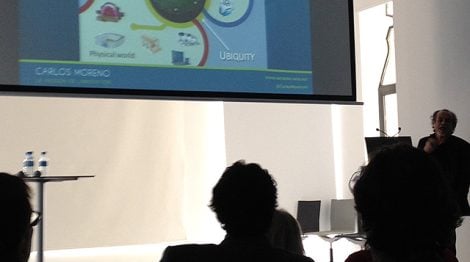
Second day at the Smart City Expo World Congress – 2013, which kicks off with a plenary session featuring top-level speakers to discuss the future challenges of Smart Cities. Antoni Vives –...


Second day at the Smart City Expo World Congress – 2013, which kicks off with a plenary session featuring top-level speakers to discuss the future challenges of Smart Cities.
- Antoni Vives – Deputy Mayor for Urban Habitat – Barcelona City Council.
- Pedro Paulo Carvalho – Chief Secretary of the Civil House – Rio de Janeiro.
- Charbel Aoun – Senior Vice-President for Smart Cities – Schneider Electric.
- Laura Ipsen – WW Public Sector VP – Microsoft.
- Henry Chesbrough – Professor, ESADE Business School, Haas School of Business – UC Berkeley.
- Moderated by: Mike Lake – President & CEO – Leading Cities – Boston.
Here is a summary of the main ideas that emerged in the debate.
Why have some cities not started the transition to Smart Cities?
Antoni Vives. We have many companies with Smart initiatives, but we do not have political leaders with a vision of Smart Cities. This change is necessary in public managers. And if it is not changed, we may find citizens tired of technological solutions that do not provide value and do not improve their quality of life. We have an opportunity, but we must all work together.
Laura Ipsen. In relation to what Antoni mentioned, cities have historically been intelligent; we are the architects of the future, and what we must do is promote public-private collaboration, generating good practices and good models with which we can overcome certain barriers. We must focus on involving the most sustainable cities with more economic development. We must focus on providing more solutions with fewer resources.
Pedro C. The challenge facing Rio is the preparation for the 2016 Olympics, which is strategic because we must produce a change in the city that lasts after the event and improves the image of Brazil. And for that, we need the citizen as part of this transition and transformation. A key element is how governments have the courage to launch Open Data initiatives to develop solutions for the city. And the other question is how the citizen participates in this process. Citizens want to participate beyond every four years; they are looking for collaborative projects that allow creating a smart city. In June, we had problems throughout Brazil, channeled through social networks, they asked us to participate in the process, and we have a governance problem that we must modify from the public sector, and it is key that the citizen participates in making solutions in the public space. This is the future challenge of Smart Cities.
Charbel A. The transition to bottom-up management is happening; there is a change regarding who takes the initiative; it is no longer just the private initiative; the citizen is starting to participate. From Schneider, we are working on it. For this, we need political leadership and the ability to debate in the city and debate about the future. Another barrier is the difficulties of understanding between the public and private sectors. Communication and understanding must be improved. Another issue is that it is necessary to improve the indicators that allow evaluating a Smart City; we have many solutions that we must unify. The city wants to choose and know the market options. We need an adequate regulatory framework, with Smart contracting systems, but we also need a new financial system that allows a combination of investments that bets on social and environmental projects. We need coordination between agents; we must learn to work with combinations of 20 actors. We can contribute a lot from the private company, but also from the European Commission.
Antoni V. In relation to what Pedro mentioned, we need global standards that allow the evaluation and comparison between cities, that allow knowing the routes to travel hand in hand with large corporations. We are working on this protocol, and we need to be convinced from the public sector of what the private sector offers. But the technological offer must be adapted to each city. We are tired of pilot experiences; we do not want more pilot solutions. In BCN, we have the Smart City Kit, which is scalable and expandable to other parts of the city and other cities.
We need to have real visions; we want a BCN that is a self-sufficient city and connected with the world; we want to have mini-Smart Cities; each city must have its vision, and the private initiative must ask for this vision. This is the work we do from UN – Habitat Barcelona. Business models with short payback periods of 3 or 4 years are necessary, no more.
How do you see the experience of pilot projects from the private sector?
Laura I. The worst thing that could happen is that we all develop pilot experiences. We must take advantage of what has been invested and make the solutions profitable. When we commit to the city, we work with workshops that allow identifying the solutions and how to scale them. Pilot experiences are issues that bet on the future. We must have transparent models open to the citizen. That allows evolving the pilot experiences, that reaches the universities and that leverage entrepreneurship. An example is Bismark as a start-up that has gone further and is no longer a pilot experience. We cannot satisfy the public’s concern for quick results; we must value them and then be able to transfer and replicate them. We must flee from pilot projects and move towards sustainable projects.
Charbel A. The pilot allows us to see the maturity of the technological solution; if it overcomes the beginning, it allows us to scale and commercialize it. The question is how to get out of the pressure of the cities that want to show their progress and the companies to evaluate their bet. I think the pilots contribute, but I agree with Antoni, we are tired of the pilots.
Pedro C. The important thing is the maturation period of the pilot project. In Rio, we have such great challenges that the solutions and investments are long-term, how to develop these projects that go beyond what people live. Another problem is the contracting process that must be different for these pilot projects due to its rigidity, and these projects require more flexibility. There is a need to test these solutions and the perception of people.
Antoni V. What Pedro comments is interesting. My criticism of the pilot projects is because the most dangerous thing is an architect and a mayor with little vision who promote useless projects for the city, and this gives rise to immature solutions, we need long-term solutions. In BCN, we have valued that we need 15 years for structural projects and to be able to make them profitable. The investments must be made with a vision of the future and have the support of all political parties; the pilots will make sense if they are scaled to reality. We do not want pilot projects to commercialize technology.
How do we facilitate bottom-up approaches in Smart Cities?
Charbel A. As a citizen, I do not have the ability to see the city as a politician or as an official. When things happen that I do not like, I complain; the efforts for the city are not visible; to engage citizens, it is necessary to identify the priority projects. Defining the vision of a Smart City requires taking the pulse of the city and knowing what its needs are, and this translates into better habitability for citizens. This citizen commitment is necessary.
Antoni V. We have to find a balance between the strategies of the city and what the citizen perceives. We need to discern the basic applications for the city. We need to explain what a smart city is to all audiences.
Pedro P. To involve the citizen, a trained administration is necessary, with trained leaders; in Rio, we are training 200 leaders of the future, and we are working on the idea of a smart city. On the other hand, there is a trend towards transparency through Open Data to generate innovation but also to generate useful information for the citizen, to publicize what the administration is doing. In Rio, we have the Operations Center, and the press has a permanent center within the center; we offer first-hand information to communication companies. These are mechanisms to involve the citizen in Smart City projects.
How can cities improve public-private collaboration?
Laura I. There are important issues in the city protocols; the private sector can improve collaboration with each other. From Microsoft, we have almost 400,000 partners with whom to share within this global framework; we can involve more citizens and provide better services. The academic sector also has a lot to say; we are investing a lot in universities. We must overcome barriers, and the private sector can contribute more. We must move from proprietary systems to more open systems. And here, Big-Data is a vital issue for cities; there is sensitive data, but others can be very interesting to open.
Next steps for the future status of Smart Cities
Charbel A. For Schneider, it is necessary that the city define where it wants to go, that it does not arrive by chance. Cities are a network of actors that interact, and the academic sector has a lot to say. As companies, we cannot deal with the problem of watertight public departments; we can facilitate the change, and this is a paradigm shift. We do not believe in holistic integration; we believe in the integration of solutions; we have to have an integration based on the need and the value it generates.
If we have some foundations, this is the basis for growth, and Open Data will facilitate access to investors, and the community will see it better.
Collaboration is necessary; a Smart City is a system of systems; it is necessary to integrate all the agents in the smart city. We must collaborate between the different pieces of the puzzle. It is a collaboration to create a market; the subsector is a market under construction, and from the private sector, we must sit down with the city to create it.
Antoni V. I cannot add much more, but two issues. But integration requires explanation. Integration is happening in the city; it is not about all the departments sitting at the same table; we must think in social terms, and BCN has been working since 1850 because it is a social dream; we must all make the Smart City a contributor to make this dream a reality.
Pedro C. In relation to what Charbel has commented, I think there is a very important issue of sharing the responsibility of innovation with people. The challenge of Open Data is a difficult challenge; it is complicated to open the huge amount of data that we have. Another challenge is the ability to work in a network with other cities. Cities are the most conducive environment to share and generate the main answers to the challenges of the future.
Laura I. We have all talked about how necessary the vision of Smart Cities is, but it is also necessary to have a roadmap of how to reach this vision. Technology is part of the solution. When working with the different AAPP, we find the lack of collaboration and sharing information between departments; we must think of a more sustainable future. We can generate technological tools that facilitate this roadmap.