LoRaWAN in Smart Buildings: Connectivity without Wires or Limits
Discover why LoRaWAN technology is one of the best options for smart buildings. With great range and minimal consumption, it is capable of connecting hundreds of sensors wirelessly, reducing deploymen...


What is LoRaWAN and why is it so Crucial for Smart Buildings?
LoRaWAN is a LPWAN (Low Power Wide Area Network) wireless communication protocol designed for IoT applications. It operates in unlicensed bands that may differ in various regions (Europe 868MHz), offering a range of up to several kilometers and the ability to penetrate concrete and metal.
The protocol is also geared towards optimizing information transmission (very few small-sized messages) and, therefore, results in very low consumption. Thus, devices can be kept running for up to ten years with standard batteries.
These characteristics make LoRaWAN one of the best options for Smart Buildings, as it allows the creation of private networks without depending on operators and can be integrated with existing management systems. According to the LoRa Alliance, the organization that coordinates the definition of the protocol and promotes the ecosystem, the installed base of devices continues to grow year after year.

Now, how do these characteristics translate into tangible benefits for Smart Buildings? Let’s take a look below:
Key Advantages of LoRaWAN in Smart Buildings
- Fast and economical installation
A LoRaWAN Gateway can generate a network extensive enough to cover several floors. The sensors are easily placed in the desired location and start transmitting in minutes. Because many of them are powered by batteries, there is no need for wiring for power (in the vast majority of LoRaWAN nodes). The LoRa Alliance summarizes this philosophy in the OHIO (Only Handle It Once) rule: “the less time a technician touches a device, the lower the installation cost and, therefore, the greater the return on investment.” - Low consumption and long autonomy
Although powered by batteries, LoRaWAN nodes can have an autonomy of several years. Therefore, in most cases, the need for wired power is eliminated, and frequent interruptions to charge or change batteries are avoided, a critical factor when sensors are installed in false ceilings, hard-to-reach technical rooms, or remote locations. - Mature, open, and secure ecosystem
There are numerous manufacturers that offer LoRaWAN devices. The catalog is very extensive: counters, equipment for counting people, environmental quality sensors, leak detectors, current meters, controllers for air conditioning systems… As LoRaWAN is a standard and open protocol, it is possible to install and integrate equipment from different manufacturers, ensuring communication between them. In this way, they can be integrated seamlessly into a BMS system or IoT platform.Also, the connectivity between LoRaWAN devices is secure, thanks to each device having a unique ID and using 128-bit AES encryption, guaranteeing robust and protected communication.
Most Common LoRaWAN Applications in Smart Buildings
Thanks to its ability to connect sensors wirelessly, efficiently, and securely, LoRaWAN enables a wide variety of applications in smart buildings.
Among the most common, the following stand out:
- Energy efficiency: sub-metering to perform segmented consumption analysis, both for electricity and water or gas, and detect possible deviations.

- Environmental quality: analysis of user comfort and automation of processes, such as automatic adjustment of ventilation, through temperature, humidity, CO₂, particle, or other pollutant sensors.
- Space management: counting people to control capacity, occupancy of meeting rooms, dynamic reservation of workstations, and adapting climatic conditions based on occupancy.
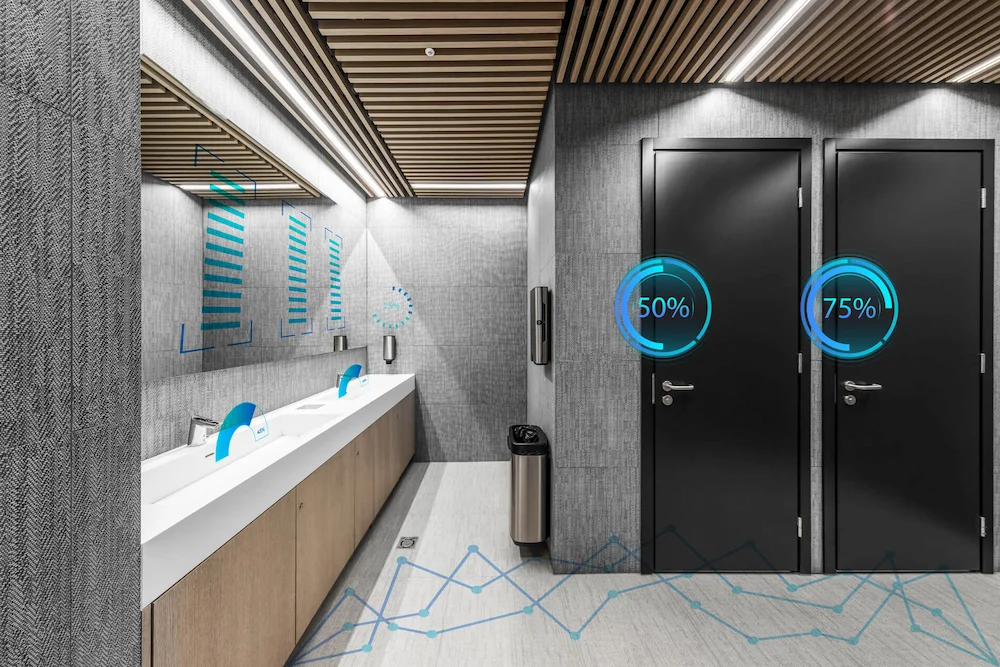
- Smart cleaning: cleaning based on actual use of bathrooms. Taking into account the total number of people entering a bathroom, uses of toilet stalls, and other variables such as level of consumables, odor, humidity, we can know when a bathroom has been used more and send cleaning teams only when needed.
- Machinery monitoring: control of HVAC, elevators, and critical equipment through vibration and temperature.
- Early detection of leaks and humidity: alerts that help prevent structural damage.
LoRaWAN and its Great Value for Facility Managers
LoRaWAN greatly facilitates the centralized management of buildings for Facility Managers. For example, a single LoRaWAN gateway can collect information from numerous sensors and connect through standard communication protocols, easily integrating with a BMS system or IoT platform to centralize alarms and dashboards.
LoRaWAN permite reducir el consumo energético, simplificar la instalación, ampliar la vida útil de las baterías y minimizar las visitas de técnicos. Analiza cómo estos beneficios se traducen en un retorno de inversión real y medible para tu edificio inteligente.