


CQ485: RS485/422 Repeater and Isolator – CQ485_U_1
RS485 and RS422 repeater, converter and isolator in a single device. Both sides are galvanically isolated. Communication speed up to 921.6 kBd. Easy-to-configure software included. Configuration via USB interface.
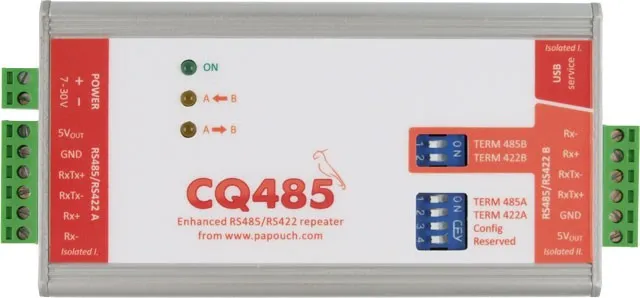


CQ485: RS485/422 Repeater and Isolator – CQ485_U_1
RS485 and RS422 repeater, converter and isolator in a single device. Both sides are galvanically isolated. Communication speed up to 921.6 kBd. Easy-to-configure software included. Configuration via USB interface.

- Galvanic isolation
- RS422
- RS485
- Papouch Converters
CQ485 is an RS485 and RS422 repeater, converter, and isolator in a single device. Both sides are galvanically isolated. Communication speed up to 921.6 kBd. Easy-to-configure software included. Configuration via USB interface.
Where is this Isolator/Repeater Needed?
RS485 and RS422 lines are often used in industry. Although these lines are very resistant and can extend up to 1200 m, a repeater or isolator is sometimes needed. When? Let’s see:
- If you want to go beyond 1200 m.
- In the event that you use a star connection (the line is not connected as a bus), you will need to isolate the distant points of the star.
- When the device is not galvanically isolated from the power supply (against ground loops).
Communication Interfaces
CQ485 has two communication interfaces; each of them can be configured as: RS485, RS422, or RS422 multimaster. Both interfaces are completely isolated from each other. Depending on the configuration, you can have an RS485 or RS422 isolator/repeater. Or you can convert RS485 to RS422 and vice versa while isolating those two. RS422 multimaster is also available.
Features
- Complete galvanic isolation (including GND) of both lines from each other and from the power circuits
- Second galvanic isolation of both power supply GND lines (optional)
- Complete signal reconstruction (depending on the mode)
- The RS485/422 line (including the ground connection) is completely isolated from the USB and the power supply (this isolation is provided as standard for all types)
- Optionally, second galvanic isolation of both lines from the power supply ground.
- Transmission speed up to 921.6 kBd
- Improved overvoltage protection for both lines.
- Automatic direction control without delay.
- Wide range of supply voltages
- Easy configuration via the supplied software (or via terminal) through a USB interface.
- Easy installation.
- Adjustable termination including resistors that define the idle state of the line.
- All signals connected through a sliding terminal.
- Robust metal housing with optional DIN rail support
Transmission Modes
The CQ485 module can operate in these three data transmission modes:
- Passive mode: the data is formed by TTL circuits; the converter does not introduce any delay in the signal.
Passive data transmission. Corrects signal edges: no noticeable delay is added to the transmission. (yellow – data input; light blue – data output)
- Passive mode with timing: This mode is suitable for special communication lines such as Mitsubishi’s CC-Link, or in special types of MODBUS RTU where it is necessary to separate individual packets. CQ485 inserts a delay of the configuration length behind the last stop bit. During this time, CQ485 remains firm.
This mode works very similarly to passive mode. The addition is in setting the delay after receiving the stop bit. The following example shows a converter with a delay of 400 µs. (yellow – data input; light blue – data output)
- Active mode: data is received and transmitted by a processor where it is completely reconstructed. The delay coming from that process is one byte.
Active transmission mode: data is received and transmitted by a processor where it is completely reconstructed. The delay coming from that process is one byte. (yellow – data input; light blue – data output)
CQ485 Configuration
Most parameters (in addition to the termination and resistors that define the idle state) can be adjusted via the USB interface on the side of the CQ485 module. For this, added software or any terminal program can be used (for example, Hyperterminal, which is included in the Windows operating system).
Related products

Looking for more information about this product?
Complete the form, and we’ll contact you.