


S7 for Windows ® Version 7 – 10020
To efficiently and conveniently program the Siemens series S7-300 and S7-400 PLC controls, IBHsoftec provides the S7 for Windows® software. This software can be combined with S5 for Windows® or run independently.

S7 for Windows ® Version 7 – 10020
To efficiently and conveniently program the Siemens series S7-300 and S7-400 PLC controls, IBHsoftec provides the S7 for Windows® software. This software can be combined with S5 for Windows® or run independently.

- MPI
- PPI
- Profibus (DP, FDL, FMS, PA)
- RFC1006, ISO Over TCP
- Ethernet
- Field Bus
- Serial
- IBHsoftec S5 and S7 for Windows
New in version 7:
- OsciCam
- LogView
- Intelligent input assistance
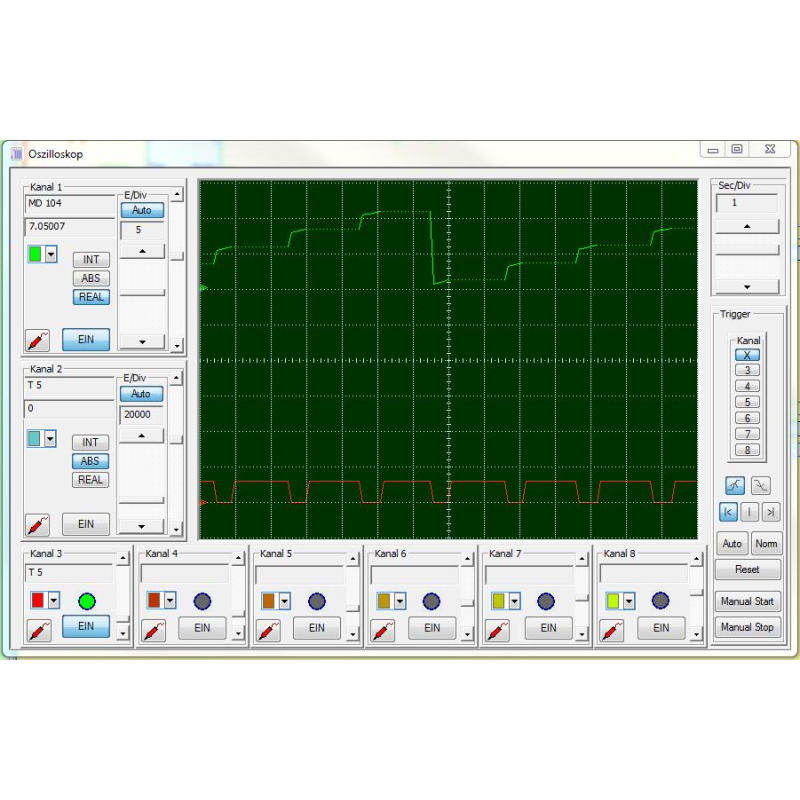
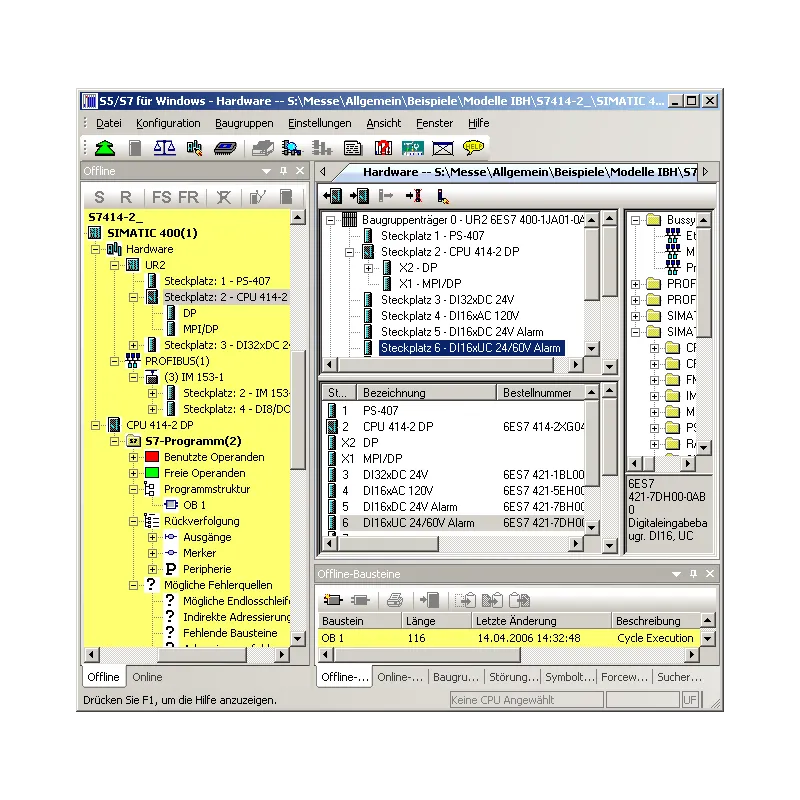
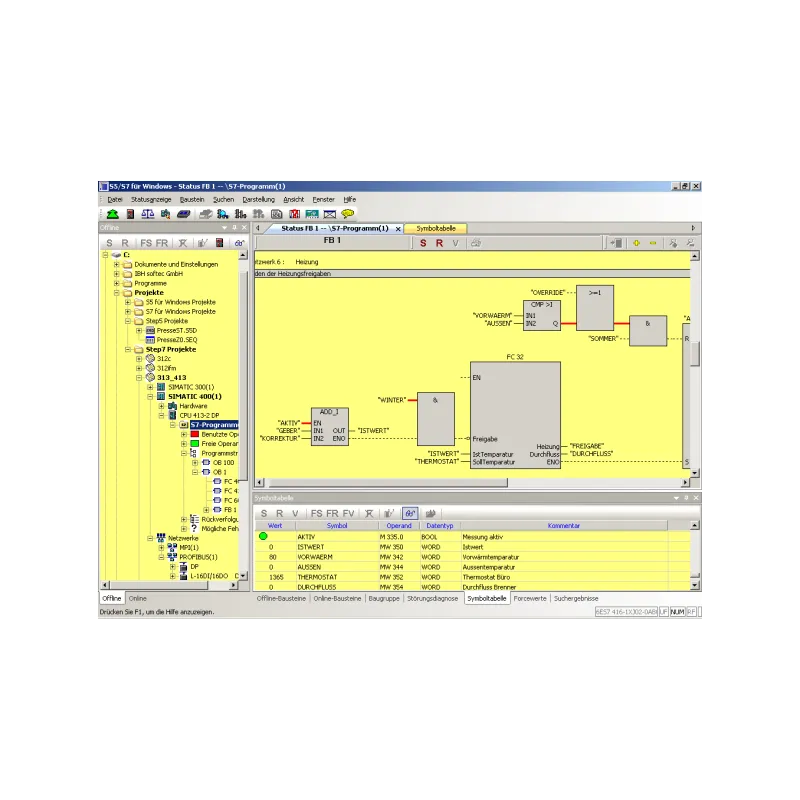
To efficiently and conveniently program the Siemens S7-300 and S7-400 series PLC control, IBHsoftec provides the S7 for Windows software. This software can be combined with S5 for Windows or run independently. With S7 for Windows, the entire series of Simatic S7-300 and S7-400 PLC controls can be programmed. The complete S7 instruction set is implemented in the Instruction List (STL), Function Block Diagram (SFC), and Ladder Diagram (LAD) presentations. Of course, all online functions are implemented. The new operating concept of version 7 has been developed based on the latest knowledge in operator guidance. Block lists and symbolic tables, for example, can be freely arranged, drawn in any order from the main window to a second screen, and automatically faded from the main window to gain more screen space. The presentation of the module parameters has also been adjusted. With S7 for Windows, the complete S7 instruction set can be displayed in the STL (Statement List) representation in the status view. The status operation is also possible in the Function Block Diagram (SFC) and Ladder Diagram (LAD) representations. In addition, variable views and symbolic tables are integrated into the status window. All installed interfaces capable of connecting to a PLC are displayed in the online view. All STEP7 projects can be edited directly without importing/exporting. Archived STEP7 projects can be opened directly. All write accesses to the PLC can be prevented by password protection. Signal (operand) traceability is possible. Cross-references can also be made on complete I/O modules and hardware or module diagnostics. Print preview and operand forcing are also implemented. The conversion of S5 to S7 programs has been optimized. It is also possible to save complete S7 projects on a memory card (depending on the CPU). Version 7 contains S7 Simulation and convenient block comparison (BlockDiff). S7 Doctor functions are also integrated for automated problem solving. S7 for Windows enables fully automated debugging in the running PLC program. Compared to classic debugging, S7 for Windows performs all the necessary tasks during debugging and returns the reason for the stop in plain text. Unlike conventional diagnostic tools, no special adaptation of the PLC program is required. The OsciCAM allows analyzing motion processes by synchronizing previously recorded videos and process signals. The recorded videos can be displayed synchronously to process signals and a recorded block status of the PLC with time stamp. With the Statusrecorder, dynamic procedures can be explored by post-analysis of the block status frame by frame. The Statusrecorder records the block status and displays it with time stamp, allowing subsequent switching between the STL, CSF and LAD presentations. With the Oscilloscope function, the diagnostic capabilities of the programming system are further enhanced. Dynamic processes can be monitored and analyzed on an integrated screen, with an adapted appearance of the front panel of an oscilloscope. Pointing to I/O signals with a virtual test probe is sufficient to monitor multiple signals within the virtual oscilloscope. The signal recording can be stopped at any time to perform a more detailed investigation of the machine failure. In addition to observing the I/O signals, the status of the local variables can also be observed at a defined position of program execution, simply by pointing to the variable with the test probe in block status. Only the integration into the S7 for Windows programming system makes this possible. The recorded data can also be saved for further investigation, for archiving purposes or to send the information by e-mail. The hardware configuration allows the parameterization of modules, the assignment of addresses and the configuration of a PROFIBUS. Clicking on the module in the configuration opens a dialog that allows configuring the module parameters. In the details window of the module or CPU, the executed changes are clearly marked, to avoid unintentional changes before saving. In addition to the original Siemens PROFIBUS components, our hardware catalog contains PROFIBUS components from other manufacturers that are compatible with Siemens. The hardware catalog can be extended with files in GSD format. The hardware configuration of existing Step7 projects can be read and edited. In addition to the offline creation of hardware configurations, it is also possible to read and edit existing configurations from a PLC. For rapid debugging, module diagnostic functions are integrated. The hardware catalog is constantly updated to obtain the latest modules. These updates are available free of charge via the Internet.
Related products

Looking for more information about this product?
Complete the form, and we’ll contact you.
Contact Product Catalog Industrial Hardware
"*" indicates required fields