Challenges in Building Communications: Connecting Multiple Systems with a BMS
In modern buildings, integrating multiple technological systems poses significant challenges to ensure fluid and efficient communication. Discover how to face them with a BMS.


The incorporation of new systems in buildings presents significant challenges to ensure fluid and efficient communication between them.
With the increasing integration of advanced technologies for the intelligent management of air conditioning or lighting, access control, or electric vehicle charging, modern buildings face significant challenges. These include the need to overcome technical barriers such as protocol compatibility, reduce latency in data transmission, ensure the security of communications, and adapt to diverse infrastructures such as hospitals, shopping centers, or sports facilities.
In this context, Building Management Systems (BMS) act as the core of a connected building. These platforms centralize the management of complex and diverse systems and help achieve new levels of operability, sustainability, and energy savings. Let’s see how:
Refrigeration, a Key Component in Energy Management
Refrigeration, an essential function within HVAC (heating, ventilation, and air conditioning) systems, represents approximately 40% of the energy consumption of buildings and is one of the fastest-growing applications. In a context of increasing energy costs, it is essential to optimize the energy efficiency of these systems.
In this sense, BMSs allow these systems to be optimized through the monitoring and control of key parameters such as temperature, humidity, and operating modes. However, it should be taken into account that not all HVAC systems are compatible with BMSs, which reaffirms the importance of solutions that enable seamless integration to maximize energy savings and improve sustainability.
Unifying HVAC Systems
Integrating HVAC systems into a BMS allows access to essential data such as energy consumption, temperature, humidity, and alarms.
In VRF (Variable Refrigerant Volume) installations, specialized algorithms such as the Power Estimation Algorithm (PEA) allow the analysis and management of consumption in real time, enhancing sustainability and energy savings.
Tangible Advantages of Integrating HVAC in a BMS
- Energy saving: optimizes consumption by adjusting setpoints and schedules based on occupancy.
- Preventive maintenance: detects problems early to reduce costs and prolong the life of the equipment.
- Automation: coordinates automatic responses to critical events, such as fire alarms.
- Centralized control: allows managing multiple locations from a single control point.
- Improved comfort: increases the comfort of users, encouraging permanence in commercial spaces.
Breaking Barriers: Connectivity between Factory and Building
The diversity of protocols between factory and building systems is recurrent: while factories use protocols such as Profinet or Ethernet/IP in their PLCs, buildings operate with standards such as BACnet, KNX, or DALI.
Connecting both worlds through a BMS allows applications that enhance efficiency and safety, such as:
- Automatic shutdown of HVAC in emergencies detected in the factory.
- Reduction of energy use by synchronizing work shifts with the BMS.
- Monitoring of industrial KPIs from the building system.
- Bidirectional alarm management between factory and building to respond to critical events.
Thus, effective integration through a BMS, in addition to improving operability, fosters intelligent and connected collaboration between both infrastructures.
Integration of Electric Chargers: OCPP and Intelligent Charging
The adoption of electric vehicles (EVs) requires integrating charging stations (EVSE) into existing infrastructures. In this context, BMSs play a key role by allowing the incorporation of charging stations into the building’s ecosystem, managing their operation in a centralized and coordinated manner with other systems.
In addition, the Open Charge Point Protocol (OCPP) facilitates communication between charging stations and central management systems. This standard enables advanced operations such as session authorization, transaction management, and intelligent charging, optimizing the energy balance and enabling bidirectional capabilities (V2X). These functions can be integrated into a BMS to facilitate their coordination with other building systems, reducing demand peaks in contexts such as factories and commercial car parks.
Smart Metering: Consumption Data for your BMS
The measurement of resources such as electricity, water, gas, and heat is essential to optimize consumption in buildings. The protocol M-Bus, widely used in smart metering, facilitates data collection from meters, adapting to various network configurations to ensure flexibility and scalability.
By integrating this information into a BMS, it is possible to centralize the analysis and make data-driven decisions to reduce costs, improve energy efficiency, and move towards sustainability.
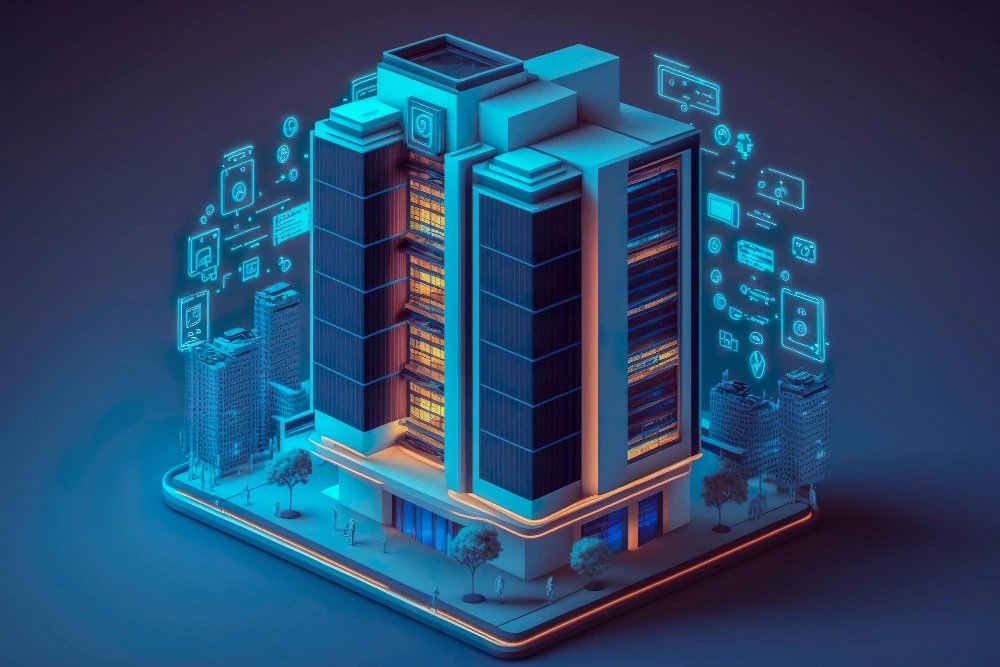
It is clear that connectivity in modern buildings, more than a trend, is a necessity to ensure operational efficiency, energy savings, and sustainability. In this framework, BMSs have become the solution to transform challenges into opportunities, creating smarter and safer environments.
En Becolve Digital contamos con herramientas que garantizan la integración efectiva de sistemas y equipos, adaptadas a tus necesidades concretas.