Unified Control Center for the Integral Water Cycle.
A Unified Control Center (UOC) is capable of encompassing the operations carried out in the different systems of the water sector, increasing efficiency in the operation and enabling standardization.


The water cycle management comprises several systems that require real-time information processing. All these systems belong to the integral water cycle and could be generally classified into different stages, with their management being different for each specialization group:
I Systems for Collection and Energy Generation.
Water accumulated in reservoirs, wells, or springs is collected. The energy from the process is used for its transformation into electrical energy. These systems are usually far from the destination cities and require a variety of countless sensors, collecting information from places that are often difficult to access.
I Treatment Systems.
Several geographically separated WWTP plants control the actuation elements through the information received by the instrumentation of each of the plants. These systems require operation in local mode and remote access from a unified control center. In coastal areas, the installation of desalination plants is common, which have a high complexity and require an exhaustive analysis by the control and quality engineers.
I Systems for Transport, Storage and Distribution.
Numerous distributed facilities require local control, as is the case of pumping stations, and the monitoring of sensors that guarantee the quality of the supply.
I Sanitation Systems.
Before returning the water to the course of the rivers, there are processing plants, WWTPs, which ensure that the environmental conditions remain stable, as required by the governmental bodies.

The complexity in the water sector, therefore, lies in the variety of systems to be controlled in situ and their management from a unified center, from where it is necessary to interact with other business tools, which guarantee compliance with the current applicable regulations.
Graphically represented in the diagram below, all these systems in Real Time (WWTP’s, WWTP’s, Pumping stations, Desalination plant, Meter reading…) are operated from several areas of specialization, such as operations, engineering, control or maintenance. In addition, one of the most requested requirements is the possibility of interacting with business solutions for information processing, geolocation, report generation or the generation of requests for specific actions (ERP, billing, purchasing, security or marketing). Performing all the necessary functionalities by any of the areas of specialization, requires an interface with native communication between applications or parts of systems, that this interface is robust and, finally, that it is efficient.

In solutions developed in water clients, we have found a wide range of PLC technologies interacting with the instrumentation of the plant and commanding the actuation elements, such as valves, pumps or mixers among others, which work in a transparent way, however, in each plant, the development of the SCADA solution differs graphically. For example, a control valve is represented differently in one installation compared to another, or alarms are generated and treated differently.

It is in this phase of the integration, where the visual representation and the operative part of the installations make sense and a standardization is necessary, which allows to unify the operation of the hundreds of plants. Let’s imagine a process engineer, who must make some adjustments in a process for the WWTP of one of the plants of the water manager in a community and when he has learned to interact with the plant, he must perform the same operation in another plant with a totally different interface, again to learn how to locate in another SCADA the “faceplate” of a control loop, or how to adjust the alarm parameters, losing unnecessary time and generating some insecurity in the maneuvers.
For this reason and mainly for the possibility of interacting with several plants remotely, a Unified Control Center (UOC) is justified, capable of encompassing the operations carried out in the different systems of the water sector, increasing efficiency in the operation and enabling standardization.

Understanding the concept of UOC…
How Will a UOC Help Us in the Management of the Water Cycle?
1. Have a distributed architecture.
The well-defined and physically segregated architecture will allow a plant to operate independently without being interfered by other plants, which may be in the development phase or in an evolutionary maintenance. Depending on the criticality of the process, the architecture can be designed to be redundant, fulfilling the characteristic of high availability.
2. Integration of a high number of signals.
Many times the information that is collected from a plant is excessive, repetitive and unnecessary, especially if it is not subsequently managed correctly, so attention should be paid in this regard. The UOC must be able to manage all the information collected from the field and in real time in order to process and historicize it. Today, there are successful experiences in the treatment of hundreds of thousands of signals.
3. Interconnection between systems.
The UOC will allow us to natively collect information from another installation. For example, a logic of opening a gate of the remote control of a station can make use of the conditions of variables of another remote control.
4. Versatility of visualization.
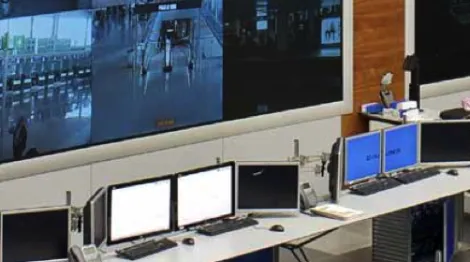
a very important feature is how to visualize the systems, through dashboards and KPI’s in videowall format, in operations station or on mobile, each user can customize their own environment. Certain users more focused on field actions, may require visualization from a Tablet or HMI at the foot of the machine. As in the image below, a first level of visualization, will allow us to locate a fault with an integration with GIS.

As we can see, starting from a good base and a well-structured UOC, we can feed it with new functionalities for a more efficient management of the integral water cycle.
If you want to know more or resolve any questions about the Wonderware Unified Control Center, do not hesitate to contact our specialists.