Use Case: LoRaWAN for Outdoor Equipment and Facilities.
The possibilities for improvement for outdoor equipment and facilities are multiple. In this post, we summarize a few with quick return and utility.

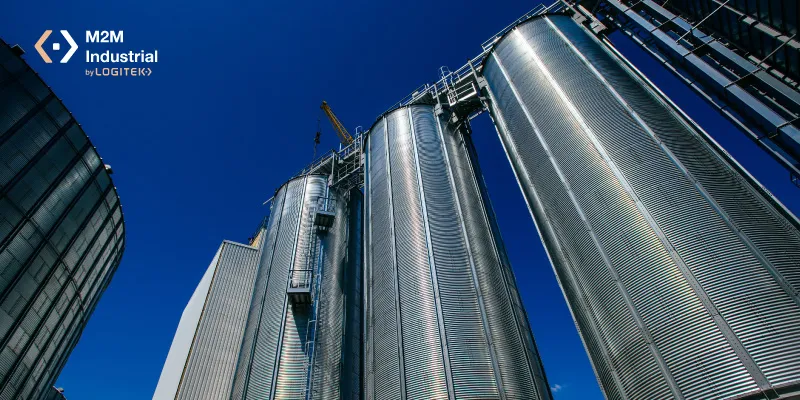
A facility linked to an industrial or infrastructure control process is more than just the factory itself or the office buildings. In the same facility, there is a set of dispersed equipment or infrastructures that need to be monitored for the correct functioning of the process. Typical examples that can be found in many facilities, whether industrial or not, may be material loading and unloading areas, parking lots, transformer substations, small treatment or water purification plants, silos, …
As they are normally far from the central factory or building, these equipments typically have little communication with the rest of the facility. It is true that there is usually a fiber run or 3G/4G communication to these locations, but they are only used to know the status of a PLC or controller that manages the site.
The level of useful information that can be obtained from these locations is much greater than the current one, although it is true that the investment they needed (in cables, infrastructures, communications, …) did not make it too viable. The most common thing is that the sensorization or control improvement projects of these sites, due to their difficulty, have become low priority.

LoRaWAN is a technology capable of reversing this situation since it allows deploying all these sensorization, instrumentation or control equipment in a simple way, both its configuration and its installation. Although in this case, without a doubt, the best property that this technology has is its range/consumption ratio. A single antenna is capable of covering hundreds of meters and even kilometers, consuming very little energy, so the equipment powered by batteries can be working for years before a replacement is necessary.
The possibilities for improvement in these equipments are multiple. In this post, we summarize a few with quick return and utility:
1 – Location Monitoring.
There are many ‘black spots’ in the facilities and their lack of knowledge can be a problem, whether to control leaks from tanks located outside, have better control of the level of the silos or the temperature at which a loading or unloading area is located, for example. Having all this information will allow you to act quickly in the event of a problem and optimize processes.
2 – Meter Management.
The first major LoRaWAN projects were made to monitor electricity, gas and water meters. It is easy to set up an application of this type, either by installing new meters in the new locations or by reading the currently installed ones – typically by Modbus RTU – to convert their values to LoRaWAN and send it to the central control.
3 – Real-time Control of Instrumentation.
Until now, the reading and control of the instrumentation distributed throughout the facility – solenoid valves, pressure gauges, flow meters, … – has been complex. It was not possible to manage it in real time, if it was desired to automate the reading, it was only possible to read the accumulated values once a day and if it was desired to control remotely, it required a costly wireless infrastructure or a large deployment of cables and control cabinets. With LoRaWAN, these devices can be read and controlled at a much higher frequency and at a low cost.
4 – Location of Assets.
It is very common that when a facility is large, certain limited material is used throughout it, such as vehicles for its displacement, small cranes or ladders, forklifts, etc. -. It is also very common that when they are needed, it is not known where they are at that moment or if someone is using it. If the last one who used it was from another shift or team, the problems are great. LoRaWAN allows the location of these assets within a facility to be able to find them quickly and not waste unproductive time searching for them.

5 – Presence Detectors.
The locations and equipment attached to a facility do not usually have personnel entering and leaving them at all hours, so it is interesting to know when someone may be entering.
In addition to the new range of improvements offered by the technology, it is very important to highlight that by choosing the appropriate architecture it will be very easy to integrate the new equipment with the current control system of the factory or facility without the need for proprietary vertical solutions. Using the appropriate equipment and tools such as KEPServerEX or OPCRouter, you can read all the values as well as send orders from any SCADA or standard control platform.
Do you now see possible improvement projects in your equipment? Do you want to check how LoRaWAN can help you to better understand your entire facility? If so, do not hesitate to contact us without obligation.