What Do You Need to Consider when Deploying a WiFi Infrastructure for Trains?
To deploy a Wireless infrastructure for trains, several aspects must be taken into account, such as location, functionalities, security, flexibility in configuration, technology, robustness and certif...


Routers Located on Land
This infrastructure is composed of a series of routers that connect to each other or to other external services through a fiber optic or copper cable trunk. However, in some cases it is not possible to have this trunk or the cost of installing it is very high. To solve this situation, there are routers with several independent radios that allow generating a Wireless infrastructure. In this way, the routers are linked in a chain to communicate with each other, and at the same time, provide the WiFi service to the trains that connect to the Access Point.

The RailTrack router is a reinforced WiFi Access Point, specially designed for trains and certified for tunnel and track infrastructure. It connects to the ground trunk through fiber optic or copper Gbps connections.
These types of routers allow intelligent and efficient interconnection between them to manage bidirectional communication with moving trains. In addition, they play a crucial role in quickly and safely managing the communication of trains with the ground infrastructure. At this point, it is necessary to take into account the roaming speed to avoid data loss during the change of Access Point of the trains during the journey. Another advantage of using WiFi for data transmission to/from the train is the bandwidth that this technology allows. Therefore, another important functionality of these routers is to guarantee a constant bandwidth at high speeds exceeding 300 km/h.
Routers Located on Board the Train
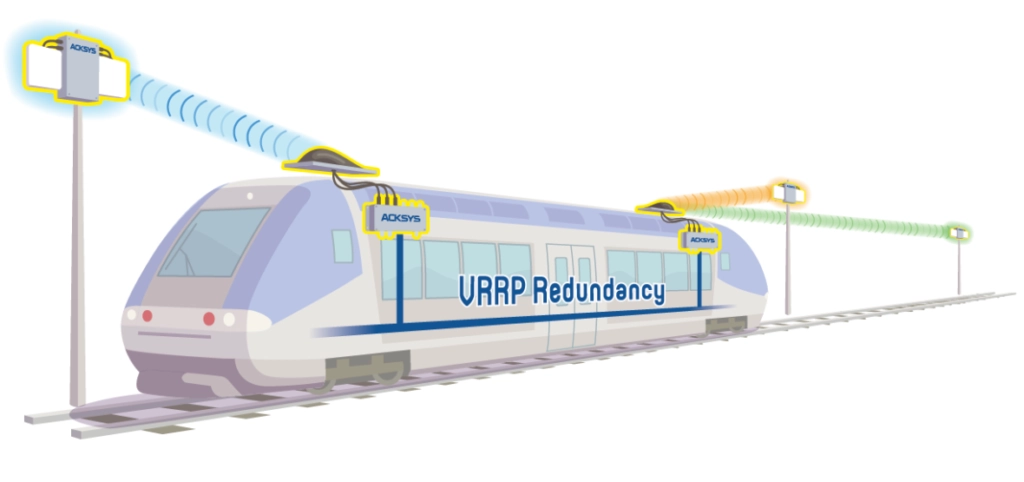
The routers that are on board the train have other types of requirements. On the one hand, it has to connect with the ground Access Points and, as far as possible, must have mobile communication (4G/5G) as a backup for sections where there is no WiFi coverage. In addition, they need to have a wireless communications backbone and Access Point for customers.
Using routers as a wireless communications backbone allows a lot of flexibility to carry out communication between wagons. In addition, it is an easy way to add services over WiFi on board. On the other hand, adding WiFi services in wagons that do not implement this technology would have a high cost and in some cases would not be possible. With a correct configuration of the routers it is possible to avoid all these limitations. Using a technology such as SMART REDUNDANT CARRIAGE COUPLING (SRCC*) any combination between wagons can be made and communication continues to function correctly.
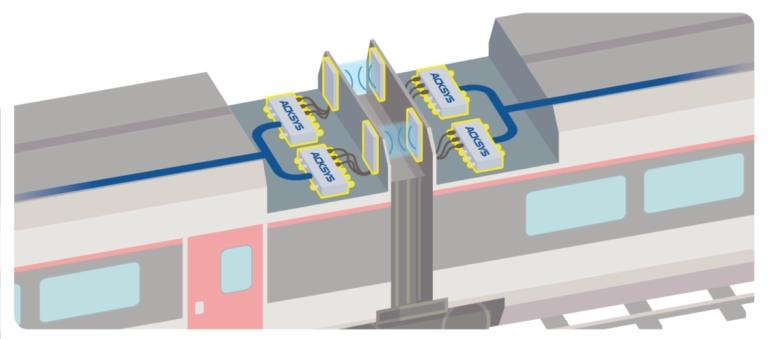
In this sense, it should be noted that the routers must have two completely isolated radios. One of them for communication between all the train’s own services such as CBTC or CCTV and another for WiFi services and WiFi for passengers. This ensures good quality links.
Having the two radios allows maintaining the two services stable and with sufficient resources to maintain a link for critical services such as infotainment.
Common Functionalities in the Wireless Infrastructure for Trains:
Security:
The security of both routers located in the ground infrastructure and on board a train must always guarantee the integrity of the communication and the protection of the data. In this way it is possible to segment the networks into VLANs, generate VPN tunnels, perform different types of authentication such as Radius and segment physically isolated radios within the same router.
Flexibility:
Configuration flexibility, the routers must allow a highly flexible configuration to be able to adapt in different environments. The radios that are located along the track can be configured as a wireless bridge and avoid cables. On the other hand, if they are in a garage they can be configured as a MESH or Fast Roaming network.
Technology:
That each router has the correct technology, independent radios, MiMo to be able to take full advantage of the technologies of WiFi 5 (802.11ac) and WiFi 6 (802.11ax), redundancy in communications and power.
Robustness:
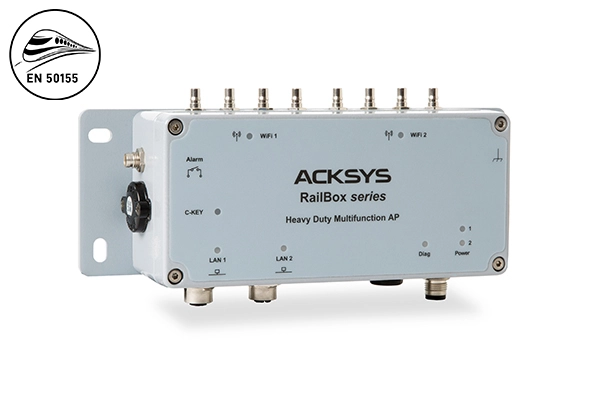
The routers must be prepared for hostile environments and unfriendly treatment. They must be prepared for the weather, bumps, vibrations, redundancy in wired communication, wireless and power supply. In addition to having some mechanism for rapid replacement, since the task of replacing a damaged device must be a simple task.
Certifications help to know what type of quality processes the router has passed and whether or not it is suitable for the environment where it has to be installed:
- Railway : EN 50155, EN 50121-3.2
- Safety : EN45545-2 (HL3), NF F16-101 (M1F1) (Fire and Smoke), EN60950-1, EN62311
- Environmental : EN61373 (shock & vibration), EN60068 (climatic)