Success story
IIoT and Predictive Asset Analytics to Reduce Failures
- Avoid catastrophic failures in power plants.
- Improve asset reliability, performance, and safety.
- Minimize the impact of common failures on production.
- Limit costs and downtime.
To control critical assets during the time between inspections, engineering determined that continuous real-time monitoring was needed.
- Empowering people with early warning notifications of equipment problems.
- Asset optimization with low-cost sensors and connectivity for high-fidelity data access that enables predictive maintenance.
- Improved operations with contextualized information.
Duke Energy is one of the largest electric power consortiums in the United States, serving 7.2 million retail customers in the United States and with an electric generation capacity of 58,000 MW.
Duke Energy had a transformer failure that led to cascading failures in other transformers and two turbines, causing damages of more than $10 million.
Duke Energy’s data analysts spend 80% of their time collecting data and only 20% of their time analyzing it.
Their general analysis procedures presented inconsistent diagnoses and limited risk assessments, leading to large economic losses.
PROPOSED SOLUTION
To control critical assets during the time between inspections, engineering determined that real-time continuous monitoring was needed.
PRiSM Predictive Asset Analytics was implemented as part of the Smart Gen from Duke Energy program.
PRiSM is software for the predictive analysis of assets, it allows modeling the optimal and normal behavior of an asset through the analysis of historical data and once in production it can detect when the equipment is deviating from its normal operating range.
With PRiSM, interventions can be planned in advance to minimize the impact on production, but also to correct a situation before significant damage occurs.
These deviations provide alarms that can alert customers days, weeks, or even months before a major problem occurs.
1. Loss of steam turbine efficiency
- PRiSM launched an alarm for low temperature of the extraction steam.
- Large amount of additional fuel burned for 8 days.
- It could have been a month or more before the plant detected the problem.
2. Problem in the bearing seal
Observation
- Peaks in the metal temperature of the low-pressure turbine bearings are observed.
Results
- The on-site inspection detected an oil deposit with half water and half oil.
- The team of engineers detected that the intricate valves were supplying too much pressure to the seals, causing water to flow to the bearings.
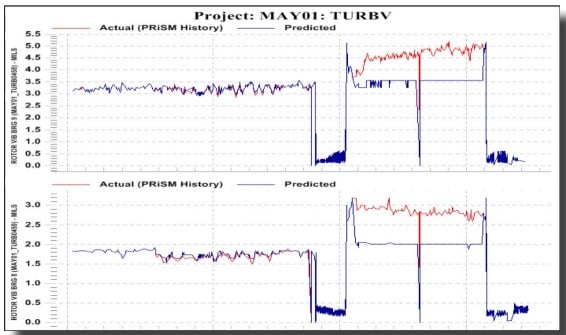
3. “Low Pressure” Rotor – Problem in the L-0 Blades
- The unit was put into service after an “outage” and there was a change in the vibrations of the bearings of one of the “Low Pressure” turbines (the vibration levels were well below the alarm level).
- The anomaly was reported to the engineering team and plant personnel.
- Vibration data was collected and the equipment was removed for inspection.
- The screws on the lower half of the flow sleeve had broken and the sleeve was contacting the L-0 blades.
- The upper half of the sleeve was no longer supported by the lower half.
- Although minor damage occurred to the “Low Pressure” blades, damage was avoided to multiple stages of blades, packings and diaphragms if there had been a blade release.