


SW485 – Splitter / Extender of RS485 – SW485
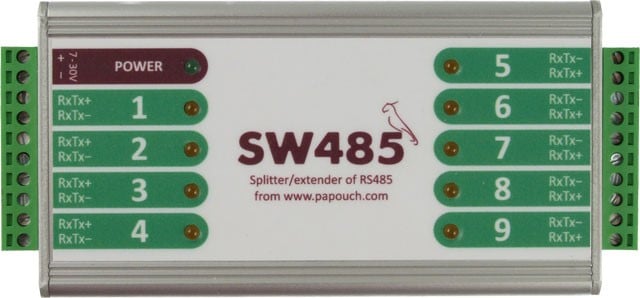
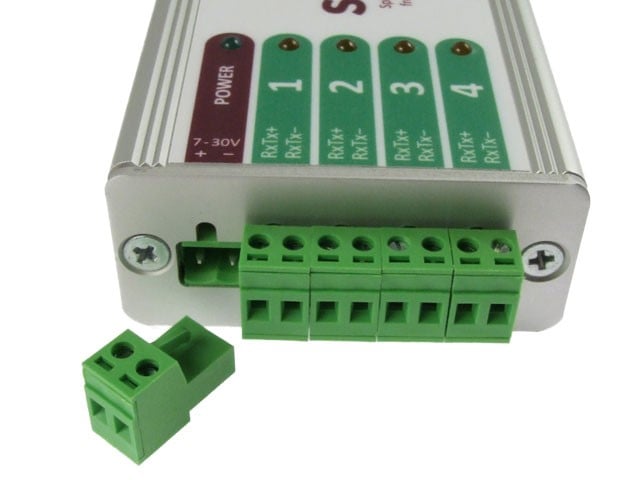
Device for the interconnection of RS485 terminal blocks (bus bars). SW485 allows connecting up to nine RS485 terminal blocks in a star topology. All lines are the same. When one line receives data, it is sent to all other lines.



SW485 – Splitter / Extender of RS485 – SW485
Device for the interconnection of RS485 terminal blocks (bus bars). SW485 allows connecting up to nine RS485 terminal blocks in a star topology. All lines are the same. When one line receives data, it is sent to all other lines.

- RS485
- Papouch Communication line switches
A device for the interconnection of RS485 terminal blocks (bus bars). SW485 allows connecting up to nine RS485 terminal blocks in a star topology. All lines are the same. When one line receives data, it is sent to all other lines.
What is it for?
- It allows you to connect RS485 in a star topology.
- Suitable interconnection of several devices communicating via RS485.
- Interconnection of RS485 networks.
- Signal edge enhancement for larger distances.
RS485 Splitter Features
- A device for the correct interconnection of up to nine RS485 lines (enables a star topology, which is normally not allowed for RS485).
- Logical processing of all signals.
- Signal transmission with a minimum delay: only 130 ns.
- Maximum communication speed of RS485 lines: 1.5 Mbps
- Possibility to configure the switching delay for automatic change of data flow direction (from 7 µs to 1.9 ms in several increments)
- User-configurable connection of termination resistors and bias resistors that define the idle state of the line. These resistors can be connected separately for each individual line.
- It can be mounted on a wall or on a 35 mm DIN rail.
- Supply voltage from 7 to 30 V DC.
How Does the RS485 Splitter Work?
In the images you can see the block diagram of SW485 and connection of several devices
The data from individual lines is only processed by logic circuits. The data received by any of the lines is sent to all other lines. Individual lines do not have a buffer for data reception.
When data arrives almost simultaneously on two lines, the system receives the data whose start was registered first. The other lines switch to “Transmission” and start transmitting the data. Once data reception is complete, the system waits for a configured period of time (the so-called “Switching Delay”). After this period has elapsed, all lines switch to “Receipt” and wait for data to arrive.
Related products

Looking for more information about this product?
Complete the form, and we’ll contact you.