


ACKSYS WIRELESS, the connectivity of the future
Wireless communication has become a fundamental pillar for the optimization of industry, infrastructure, and transportation. In addition to simplifying the way we connect, this revolutionary technology is transforming the way these sectors operate, optimizing their performance with specific improvements in each case.

Wireless Communication in Industry
Wireless communication is providing a leap in quality in the automation and efficiency of industrial processes. To begin with, connected sensors and devices allow real-time monitoring of machinery and production processes, which facilitates early detection of problems and better decision-making. On the other hand, Wireless connection enables the implementation of the Industry 4.0, which grants greater efficiency and productivity due to the interconnectivity of machines.
With the wide variety of industrial routers from ACKSYS you can establish networks with various topologies, including completely transparent bridges that replace cabling in Ethernet communications via WiFi. These networks are robust in both their configuration and hardware. In addition, many of the routers offer 4G technology and, in some cases, even 5G, which facilitates a more versatile and effective connectivity.

Therefore, among the outstanding applications for this technology, you will be able to:
- Deploy wireless infrastructure.
- Replace Ethernet cable with wireless communication.
- Provide wireless access to Ethernet devices.
- Allow mobility for devices such as AGVs, cranes, and overhead cranes.
- Allow secure remote access to the network.
- Provide wireless communication to rotating machinery.
Industrial Routers:

Compact industrial WiFi access point.
Applications: Machinery manufacturers / Smart buildings / Industrial automation.
Radios: 1.
Standards: WiFi 802.11 a/b/g/n.
Ethernet Interface: 1 x 10/100/1000.
Power supply from 9 to 48 VDC, 3-pin Phoenix connector or PoE 802.3af.

Dual industrial WiFi access point (11n + 11ac), dual band (2.4 or 5 GHz).
Applications: WiFi coverage / Industrial automation.
Radios: 1 or 2 (depending on model).
WiFi Standards: 802.11 a/b/g/n/ac.
Power supply
Redundant, 9 to 48 VDC, PoE 802.3af.
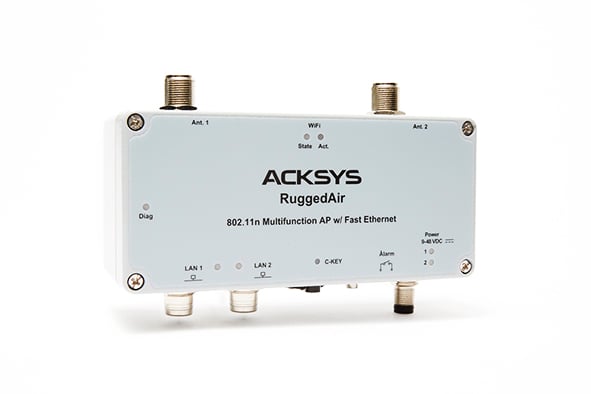
WiFi access point, client, repeater & Mesh node, designed for industrial applications and harsh environments.
Applications: industrial applications and harsh environments.
Radios: 1.
WiFi Standards: 802.11 a/b/g/n.
Ethernet Interfaces: 2 x 10/100.
Power supply: 9 to 48 VDC, redundant, PoE af (Type 1).
IIoT and vehicle wireless communication
Regarding infrastructures, wireless communication plays a crucial role in the management of smart cities. Sensors and wireless networks allow the monitoring of air quality, traffic, waste management, and energy efficiency. This not only improves the quality of life for city dwellers but also contributes to sustainability and resource conservation.
Specifically, IIoT (Industrial Internet of Things) routers allow you to connect devices with an Ethernet interface through a mobile or Wi-Fi network. These routers are designed with various interfaces that facilitate the configuration of local networks. Likewise, they ensure flexibility in connectivity, thanks to their ability to function both as access points and Wi-Fi clients.
A prominent feature of these devices is their versatility with regard to electrical power. They can be powered with a wide range of voltages, ranging from 7V to 48V, which makes them ideal for use with batteries or other power sources. Thus, they are capable of operating perfectly in various situations and environments.

What advantages will you access in the case of IIoT and vehicles?
- Enable wireless communication for any Ethernet device, such as CCTVs, ATMs.
- Geolocate vehicles.
- Manage fleets.
- Obtain vehicle data in real time.
- Download mobile asset files.
Routers for IIoT and Vehicles

M2M, IIoT (2G/3G/4G) + WiFi (802.11n) Router.
Applications: M2M & IIoT / Mobility (buses, vehicles…).
Radios: 1 mobile data + 1 WiFi.
Standards: WiFi 802.11 a/b/g/n.
Standards: mobile data worldwide LTE, UMTS/HSPA+ and GSM/GPRS/EDGE.
GNSS GPS, Galileo, GLONASS, Beidou Standards.
Ethernet Interface 1 x 10/100 + 1 x 10/100/1000.
Power supply from 7 to 48 VDC, 3-point Phoenix connector or PoE 802.3af.

WiFi 11n router and 4G connectivity with positioning (GNSS), for road and tram applications.
Applications: Transportation (bus, tram) / road (car, truck…).
Radios 1: cellular + 1 WiFi.
Standards: WiFi 802.11 a/b/g/n.
Cellular standards worldwide LTE, UMTS/HSPA+ and GSM/GPRS/EDGE.
GNSS GPS, Galileo, GLONASS, Beidou Standards.
Ethernet Interface: 2 x 10/100.
Power supply from 7 to 48 VDC, 3-point Phoenix connector or PoE 802.3af.

WiFi 11n access point, Ethernet bridge, repeater and MESH node for applications in vehicles and heavy vehicles.
Applications: Mobility (urban buses, handling/lifting, rotating machinery, automated carts…) / Exteriors.
Radios: 1.
Standards: WiFi 802.11 a/b/g/n.
Ethernet Interface: 1×10/100.
Power supply from 9 VDC to 48 VDC and PoE 802.3af.
Wireless communication on trains
Finally, there are routers certified for transportation capable of performing various configuration roles, such as MESH nodes, wireless bridges, clients, or access points. In addition, they implement advanced configuration parameters, such as Fast Roaming, VPN, and QoS, among others, which strengthen robustness and quality in both the link and data transmission.
These routers have undergone rigorous testing, even at speeds of up to 350 km/h, maintaining a bandwidth of 500 Mbps. They are designed to operate in environments with vibrations, variable temperatures, and a wide range of electrical power, ranging from 9V to 48V or, in some cases, up to 24V to 110V. This ensures the readiness of these devices to meet the most demanding demands of the transportation industry with reliable and high-quality connectivity.

In short, the distinctive features of this connectivity are:
- < 30 ms of roaming between access points that allow error-free communications.
- A redundant train-to-ground wireless link that allows continuous communication even in the event of an AP failure on the track or a client on board.
- High-speed data performance of up to 500 Mbps at 350 km/h.
How are all these advantages applied in trains?
- Providing Wi-Fi to passengers.
- Generating uninterrupted communication between the train and the infrastructure on the tracks.
- Providing M2M communication to on-board devices, through a trunked Wi-Fi.
Routers for wireless communication on trains

Applications: Hostile environments/Railway land infrastructure
Radios: 3.
WiFi Standards: 802.11 a/b/g/n/ac.
Ethernet Interface: 2 x 10/100/1000.
Fiber interface: 2 x 1000 base X with SFP cage.
Power supply from 100 to 240 VAC.
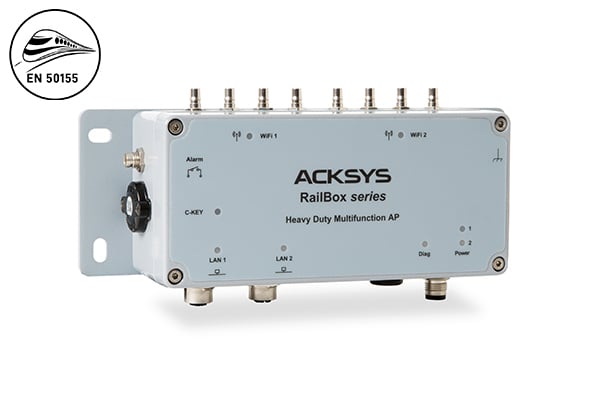
Applications: Hostile environment / Railway infrastructure, on board and on land.
Radios: 1 or 2 (depending on model).
WiFi Standards: WiFi 5 and WiFi 6.
Ethernet Interface: 2 ports, 1 Gbps or 2.5 Gbps* (*Depending on model).
Power supply Redundant input with double insulation (24 to 110 VDC*) or PoE +*. (*Depending on the model)
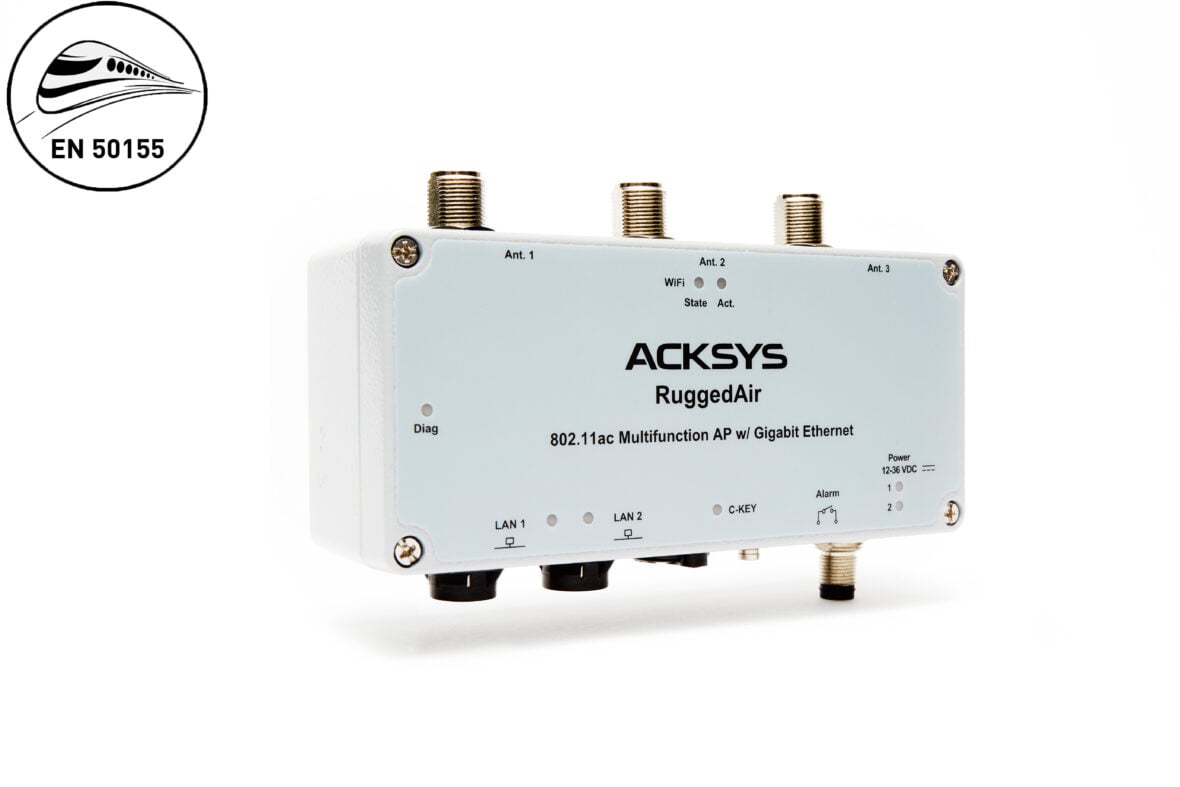
Applications: Industrial applications / Hostile environments / Trains.
Radios: 1.
Standards: WiFi 802.11 a/b/g/n/ac.
Ethernet Interface: 2 x 10/100/1000.
Power supply from 12 to 36 VDC, isolated, redundant, PoE af (in type 1).
Compatibility and administration of the various routers in the ACKSYS family
Although each model presents specific services for each sector, all ACKSYS routers operate with WaveOs, a complete and advanced operating system that offers exceptional performance in the router family. This guarantees uniformity in configuration and complete compatibility between all devices.
In our downloads section, you can access the manual and explore all the advanced functionalities of this operating system, in order to make the most of the capabilities of these routers. In addition, its administration is simple thanks to the software Wave Manager, with which you can manage and supervise all your routers efficiently and centrally.
Finally, you can unify all the routers in a single secure network with OpenVPN, capable of being configured both as a client and as a server. In this way, you can remotely access connected devices without compromising network security. With this solution, we maintain secure and efficient connections no matter where they are located.
Get in Touch with an Expert
Fill in your information and we’ll contact you.
"*" indicates required fields