The Internet of People
Big Data, Internet of Things, Open Data, M2M, SmartCities… all of these are concepts that are discussed at length on a daily basis. They are areas, ideas, paradigms that overlap, support each ot...


Big Data, Internet of Things, Open Data, M2M, SmartCities… all of these are concepts that are discussed at length on a daily basis. They are areas, ideas, paradigms that overlap, support each other, and are needed to explain each other and make sense.
The SmartCity feeds on the Internet of Things, M2M, and Open Data. Open Data from M2M, Big Data, and serves the SmartCity. Big Data should be mostly Open Data, since we are looking for, to a greater or lesser extent, Open Government (well, another concept) and also collects data from the Internet of Things.
The Internet of Things… This is the concept that will probably cause the biggest revolution since the appearance of the binary system and computers. The technology that will give a new dimension and an infinite development to all other concepts (will Big Data be called Big2Data?)
IPv6 has been here for a while and can give a unique name to any object, exactly to 340,282,366,920,938,463,463,374,607,431,768,211,456. Yes, yes, is this the “easy” part? But it is also essential! Remember that naming is giving an identity (nothing more and nothing less) and therefore, generating a new source of information from which we also know the origin.
So where is the problem? Why hasn’t this new digital revolution already occurred? Little by little. Revolutions are fast, but the road until the necessary conditions are met to trigger them can be slow, very slow.
We already know where we are on the road, we only sense the moment of the trigger.
One of the critical points is to provide the Internet of Things with an efficient system in terms of energy supply for sensors and antennas. The energy supply of each of the sensors and the number of repeaters needed to cover an entire area is a problem, which after all is all the existing surface. If the sensors are powered by traditional batteries in an environment not adapted to the new concept of the Internet of “all things”, these batteries must be changed with a high frequency, and therefore, it would not be a scalable system. Imagine the army of operators needed just for this task. Most likely, half of the sensors would end up unsupplied, either due to labor problems, inaccuracies in the organization, budget cuts… remember that the sensor is the basis of the system, the one that gives the object its name, the one that emits the information.
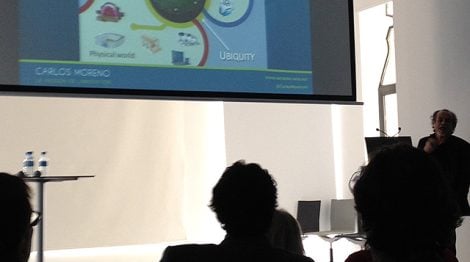
But this is not a problem either, we have a solution! The resolution of technical problems, most of the time, is quantifiable in time and budget, two variables that influence each other inversely. So what is missing for the long-awaited trigger? On June 10, the first edition of startup4Cities was held in Madrid. This was its “Claim”, which you can still read on its website:
“If you have developed an innovative idea to improve your city and would like to test it in a real scenario, this is your opportunity. Representatives from more than 50 Spanish municipalities will listen to your proposal, assess it and, if they are interested in it, offer you their cities as an urban laboratory. Is there a better prize? PARTICIPATE!”
Isn’t that quite a declaration of intent? “PARTICIPATE!”, it says at the end, “we put the city as a laboratory”. The concept of startup is increasingly used, understood as it is understood in Silicon Valley: lean method, minimum viable products, fresh ideas from teams with initiative, sacrifice, talent and a lot of passion. It is in the projects of people like those who presented themselves to this event where the trigger for the new digital revolution of the Internet of Things must occur. It may not be from a single project, but the sum of them will make visible something that is not yet. It must be taken into account that this type of project is focused directly on solving a specific problem of the citizen. A problem that the citizen recognizes as his own in the first person and that, in addition, the solution to that problem is usually presented packaged in a wonderful and free App that is very rewarding and easy to use from his smartphone, the key to his SmartCity.
And we must not forget that people are the ones who catalyze change, that is why “The Internet of Things” will be “The Internet of People”