Unified Control Center for Port Infrastructures
The implementation of a Unified Control Center in a port will act as an accelerator for the transition towards a Smart Port.


The complex operation of ports, which can sometimes resemble small cities, implies that a traditional SCADA system cannot offer the technical requirements necessary to integrate all operations.
Therefore, we propose a solution for a Unified Operations Control Center for port infrastructures, the key piece for the transition to a Smart Port.
Unifying operations such as the identification and reception of ships, access control and physical security, or the management of buildings (BMS) that are part of the port, is not an easy task if you do not have the appropriate software. Why a proposal for unifying operations? The answer is simple: because the integration of operations on the same platform will allow optimizing resources and being more efficient in operations and decision-making.
Let us remember that the objectives of a port are (among others) to improve its competitiveness in trade, to have greater profitability at a commercial level thanks to the optimization of processes and management, to improve and be more efficient in the connection with its environment and the city, and, ultimately, to improve its productivity.
We propose the following set of operations as an example. Can you imagine having them all integrated into the same Unified Control Center?

The power of the Wonderware-AVEVA UOC (Unified Operations Center) system is the great flexibility it offers both in the integration of different field equipment (such as variable signaling panels, access controls, video surveillance, gantry cranes, among many others) and in the integration of different sources of transactional information such as the ERP system, the port traffic management system, weather forecasts, among others.
With real-time access to field devices and the integration of transactional systems, a digital model of the port is created that serves as the basis for the Unified Control Center. This digital model will allow port operators (among other things) to:
- Model operations and business logic.
- Interrelate information from different data sources to make automated decisions.
- Digitize processes with its BPM functionality, as well as the exchange of information and services (workflows) between management operators, the maritime authority, the tower operator, the terminals, the shipping companies, among others. In short, connect the different actors in the logistics chain to the platform to streamline transactions and bureaucratic procedures.
- Historicize large data series and exploit them by creating Business Intelligence models. The data collected from the field elements and throughout the interactions between vehicles, people and institutions will allow better decisions to be made in the future.
- Generate KPIs and Dashboards that allow monitoring the critical parameters of port activity and acting on the systems in case of anomalies.
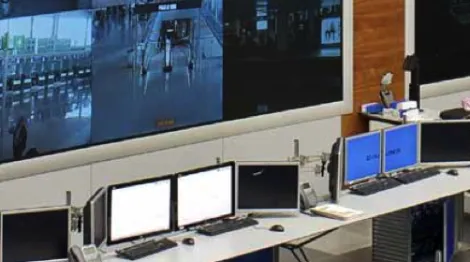
- Natively generate multi-screen views (video-wall) for the control center that allow a contextualized visualization of all operations related to the port, including the embedded integration of external applications.
All these functionalities of the Unified Control Center (UOC) will allow port managers to evolve to a more efficient model with a clear vision towards digitization. This will allow them (as is already being done in other ports such as Barcelona, Rotterdam or Los Angeles) to address 4.0 initiatives such as:
- The deployment of IoT sensors on land and sea and mobile aerial sensors (drones) and integrate them into the UOC platform. In a port, it is important to have sensors of all types and in all places, since all the necessary parameters must be captured in order to later act in real time in the face of problems or incidents; in addition, these sensors feed the Historian system to store the information necessary to start up and provide data to Big Data and Machine Learning tools with the aim of planning the future and anticipating events.
- Digitally integrate all physical security management of the port (PSIM) as well as incident resolution and alert dispatching. Also integrate the maintenance teams and the GMAO asset management platform.
- Another possibility is BIM (Building Information Modeling) and its integration with the Wonderware-AVEVA UOC. BIM offers the possibility of planning and maintaining the port’s infrastructure through the use of digital twins. The creation of a digital twin, a virtual copy of the port to help manage the port area.

- Monitoring of water columns in real time, forecasts of water level at the dock and navigation panels.
- Information shared in the system so that truck drivers know in real time the traffic situation in the port and thus increase fluidity and reduce greenhouse gas emissions.
- Optimize port traffic, improving safety and sustainability thanks to the information from the ships that is integrated into the system and the actions of the different port services.
- Container Tracking Application (CTA), which allows knowing at all times the situation of a container that passes through the port using only the container number and the ship’s scale, as well as visually integrating it into the GIS (GISIZE) system integrated in the UOC.

In short, in operations management, unity is strength and the initiatives that derive from the implementation of a UOC or Unified Control Center in the port will act as an accelerator for the transition to a Smart Port, digitization and improved efficiency.
If you want to know more about our approach to digital transformation in ports, do not hesitate to visit our specific website for the sector.