Unified Control Center for Railway Infrastructures
The unification of operations seen from the perspective of efficiency in operation, makes a unified control center solution key for the railway sector.


The management of the railway sector such as metros and trains has typically been approached with the concept of remote control. These remote controls have often been separated into silos or specific functionalities, for example:
- Energy remote control
- Fixed installation remote control
- Mobile equipment remote control.
- Traffic remote control.
- Among many others.
If this type of architecture is approached from a practical business management perspective, the first thing we find is that access to information between remote controls is necessary in many cases. And it is also very common to encounter situations in which operators of one remote control have to take part of the control of another. In this sense, you can imagine that with separate control silos and often different technologies, the companies that integrate these systems have to “juggle” to achieve a unified operation of the remote controls.
For this reason, it is clear that a control center that unifies the operations carried out in the different railway remote controls can increase efficiency in the operation of the sector.
The needs of the railway sector are particular and will condition the technology used for the unified control center to meet a set of requirements.
What Can a UOC Contribute in Railway Management?
Firstly, and taking into account the needs of distributed architectures and integration of the sector, the UOC will provide a base layer that will work at the level of data acquisition and that will be able to integrate into the same platform the different control systems (typically PLC and RTU’s) of the different stations and physical locations. Integration capabilities are very important at this point, and protocols such as OPC-UA, Modbus TCP and RTU, BACNet, IEC 60870-5/104, IEC 61850, DNP3 or MQTT (among others) must be natively supported by the system to ensure interoperability.
Following this first point, this “core” layer of the UOC system must be able to break the silos at the data management level. This means that the platform is capable of managing all the business logic, historization, alarm generation… from a common layer. However, for this to be successful, the platform must be able to allow three important things:
1. The separation of the execution of these key functionalities in different nodes (distributed architecture) and that, in addition, these nodes can work in high availability and fault tolerance. In this way, although everything is part of the same platform, the execution of the different remote controls can be separated into different nodes and locations.
2. That the UOC platform is capable of absorbing and working with a large number of field signals. Typically we can talk about UOCs of more than half a million signals to integrate, process and historicize.
3. As part of the same platform, that cross-access to data is native. For example, that an activation logic of the fixed station remote control can use conditions of variables that come from the traffic remote control. The interesting thing about this is that it can be carried out without having to replicate or duplicate signals or objects and thus optimize development.
Secondly, that the visualization layer of the unified control center offers the key functionalities for the management of railway operations:
1. Visualization of dashboards and KPI’s of the system operation in videowall format, in operator station format and in mobile format. Possibility of Situational Awareness visualizations with the possibility of topological colorations.

2. Possibility of working with roles and different visualizations so that:
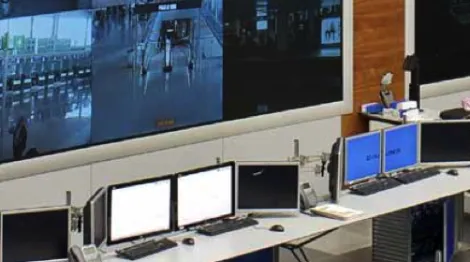
a. There are users of the Unified Control Center who can visualize in videowall format a general view of the status of the different remote controls, highlighting key aspects such as active incidents, the current status of the operation or information on key assets (among others).
b. There are specific remote control users who can manage their areas in detail and even assign areas to specific operators. For example, in the energy remote control:c. There are mobile users who can view reduced views of the remote control to apply essential actions in the field, for example, from a Tablet or an HMI in the station.

3. Integrated alarm and incident management system. Guided operation in the resolution of incidents with defined steps that indicate to the user the actions to be carried out and that also execute automatic actions.
4. Predictive maintenance tools that are capable of informing the unified control center of deviations from the normal state of operation.
5. Integration with other systems to incorporate data, for example, from an existing GIS system, the BIM model of the stations or the planning of the operation that is in the management system.6. Workflow and task planner.


6. Planner of workflows and tasks.
7. Advanced information analysis tools and data contextualization such as Business Intelligence, advanced reporting and analysis of historical data and also the possibility of performing reconstructions (moviola or SCADA Playback) in the visualization of the unified control center itself.
In conclusion, the unification of operations seen from the perspective of efficiency in operation, makes a unified control center solution key for the railway sector.
If you want to know more or resolve any questions about the Wonderware Unified Control Center, do not hesitate to contact our specialists.