What is Enterprise Asset Management (EAM)?
We explore the concept of Enterprise Asset Management (EAM) and how it can help your company.


There are different technical standards and regulations that focus on Enterprise Asset Management (EAM) and how to implement it. But before we get into the details, we must understand what an asset is. Initially, PAS 55-1:2008 defined it as:
“Plants, machinery, properties, buildings, vehicles and other items that have a specific value to the organization.”
A definition that could lead to identifying a company’s assets as those physical elements that provided value for it. However, in that public specification they already spoke of 5 types of assets:

Years later, ISO 55000:2014 expanded the definition as follows:
“An asset is anything that has potential or real value to an organization. Value can vary between different organizations and their stakeholders and can be tangible or intangible, financial or non-financial.”
This new definition was a better fit for reality. In addition, the same ISO 55:000 also tells us about what asset management is:
“Coordinated activities of an organization to obtain value from its assets”
According to this, Enterprise Asset Management (EAM) is any activity carried out by a company in order to extract value from all its assets, whether physical, financial, information, human or intangible. Likewise, asset management also includes aspects of human assets such as leadership, culture, motivation or behavior, among others, which cannot be managed through software.
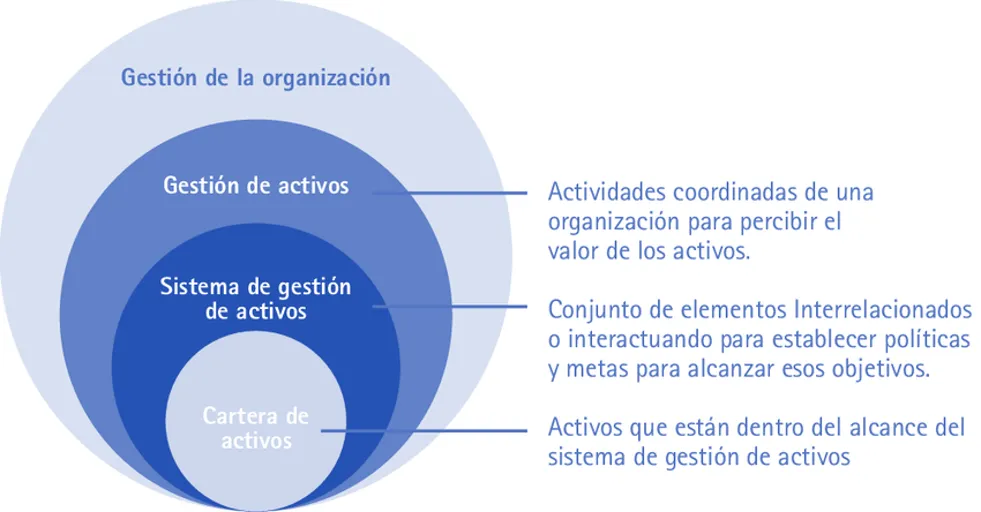
In order to standardize all these activities, there are asset management systems. ISO 55:001:2014 is the international standard that allows certifying the asset management carried out by an organization. In it, we find the most recognized definition of these systems:
“An asset management system allows you to direct, coordinate and control asset management activities in order to maximize the value you obtain from your assets.”
Thus, an enterprise asset management system (or EAM system) is software designed to manage and coordinate all the internal processes and procedures of an organization. Its objective is to extract the maximum value from the different types of assets throughout their entire life cycle.
Asset Management, Synonymous with Maintenance Management?
No. Asset management encompasses much more than maintenance management: while the latter focuses specifically on the strategies and activities necessary to maintain assets in the desired state, asset management works to offer the optimal performance of assets from the moment they begin to operate until their withdrawal.
Asset management > Maintenance management
It should not be forgotten, however, that maintenance management is a very important part of asset management (EAM), and that only an effective implementation of both strategies will ensure long-term operational and financial sustainability.
Descubre cómo la gestión de activos empresariales ha ayudado a las compañías de distintos sectores a cubrir sus necesidades concretas.