


The IT system for alarm management, supervision, and centralization

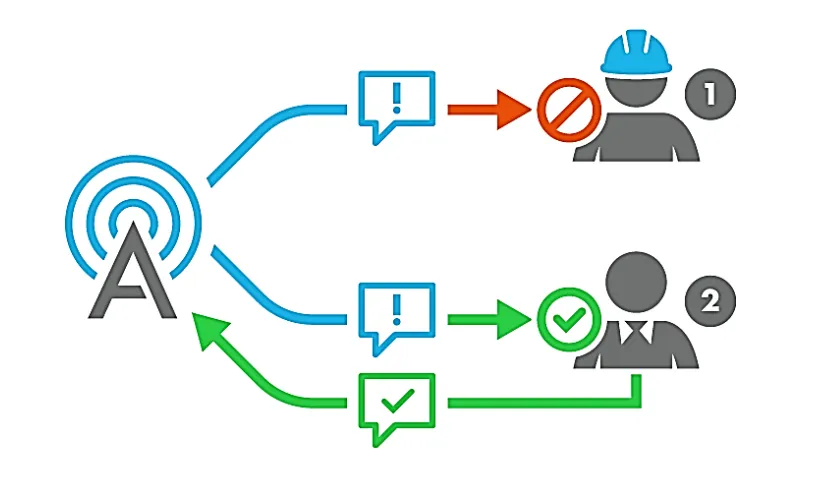
ALERT is a software product designed for remote monitoring of automated installations in the industrial and infrastructure sectors. Prevent & Alert. ALERT centralizes alarms from a supervised location and transmits them reliably and efficiently to the appropriate people, taking into account their choice of dissemination methods according to a defined schedule.
With the assurance that the information always reaches:
- The right person
- At the right time
- In the right place
- With the correct information
- Through the appropriate medium
Depending on the framework of use, ALERT adapts to the different problems of the client in order to allow reaching the specific objectives of different services such as:
Production
- Manage alarms from the production line
- React immediately after incidents and events.
- Minimize quality defects
- Avoid production breakdowns
Maintenance
- Efficiently handle technical alarms
- Organize maintenance staff schedules
- Improve the effectiveness of intervention teams
- Control your sites remotely
Management
- Optimize procedures to improve profitability.
- Create mobile solutions to optimize productivity
- Control production and facilities with a single tool
- Improve product quality and staff peace of mind
Thanks to its enormous compatibility, both in terms of data recovery and information transmission, the ALERT solution offers a true industry-telecommunications gateway that allows responding to a multitude of needs in various fields.
ALERT is used in industrial sectors with a high level of automation, such as the automotive industry, the production of consumer goods, building automation, water management, energy, the chemical and pharmaceutical industries, infrastructure, etc.
Since each field of application presents specific needs, ALERT has been designed to adapt to all environments and related problems.
A complete solution, also available on Smartphone:
- Guarantee of alarm consideration.
- Communication with multiple data sources.
- Different channels send Alerts.
- Modular Architecture.
- Control and handling of calls.
- Detailed traceability of events / alarms.
- Real-time data transmission.
- Hourly management and work shifts.
- Upward compatibility.
- Easy configuration and great simplicity of use.

A powerful tool for security, quality and productivity:
- Ensure the safety of people: Lone Worker Protection (LWP)
- Assist in the security of buildings and infrastructure
- Minimize downtime and improve productivity
- Improve the effectiveness of production management
- Assist in reducing “non-quality”
- Enable optimal use of specialized resources
- Participate in incident prevention
- Help optimize preventive maintenance
ALERTMobile
Increase the possibilities of ALERT installations with AlertMobile:
- Receive notifications
- Check its status
- Interact remotely
- Supervise
- Keep an eye on critical facility data
- Define availabilities
- These can be filled in directly via Smartphone
- Be protected
- The smartphone becomes a LWP (Lone Worker Protection) device
- Voluntary alarm
- Loss of verticality alarm
- Immobility alarm
- Surveillance alarm
- The smartphone becomes a LWP (Lone Worker Protection) device
- Location of the person
- Provide rapid assistance by locating the worker in outdoor space or in a building


The immediate benefits of installing ALERT
Complete and effective alert management
ALERT combines a wide range of technologies for acquisition, processing and dissemination:

Complete connectivity to receive alarms/data
ALERT can connect with most SCADA, PLCs, DCS to receive alarms or variables.

Many protocols and dedicated connectors
ALERT can connect with most sources.


Continuous sending of the alarm until its acknowledgment
ALERT controls the generation and reception of the Alert. ALERT keeps calling following
scenarios and on-call schedules, until the alarm is acknowledged through a continuous calling process.
Information sent to a wide range of media
ALERT can use many output communication media:

Schedule management
ALERT allows managing shifts and teams according to their schedule and availability. Calendars are configured and maintained in a very visual way. In the event of a failure to call active operators, alternative scenarios are configured to guarantee the correct transmission of information.
Traceability of events, participants, actions
ALERT integrates different tabs to analyze:
- Alarms:
- Status: Active not silenced, silenced inactive, hidden
- Note: the alarm signal in ALERT can be transmitted in the SCADA
- Records:
- The calls made, the media used (Voice, SMS) the silenced:
- The person called and who silences the alarm
Always Alert
Reliability and high availability. To have even more security in the event of system failure and maintain a high level of availability, ALERT can be installed redundantly:

Technical specifications
Insofar as ALERT is called upon to work with other applications and may have to deal with a considerable amount of information, it is recommended to provide for a comfortable hardware configuration:
- Processor 4 cores or more, operating at 2 GHz minimum
- 4 GB minimum of RAM.
- Hard disk 128 GB minimum.
ALERT works in a Windows environment (32/64 bits), desktop or server version, on physical or virtual stations.
The use in a virtual environment is entirely feasible, but may impose some restrictions related to the means of communication. For more information, see the specific section of our FAQs by clicking here.
As for the ALERTMobile application, it is available on Android and iOS.
An ALERT license is mainly defined by the number of variables you want to monitor in the software, a variable is defined by a source (in the case of a simple variable), a source and a condition (in the case of an event or an alarm).
In the standard version, ALERT is offered in 7 variants depending on the maximum number of alarms you want to handle: 25, 50, 250, 500, 2500, 10,000 or unlimited.
Although ALERT is an IT solution, it may require, due to its scope of application, the use of specific hardware materials, specifically to be able to interconnect with telecommunications systems.
Thus, depending on the type of notification chosen and the technologies available on site, modems (GSM, analog, digital) may be necessary to meet the needs.
In the case of an installation in virtual environments, and if «all IP» solutions cannot be used, IP/Serial converters can allow the use of some modems in IP (GSM and analog modem).
Get in Touch with an Expert
Fill in your information and we’ll contact you.
"*" indicates required fields