


Airports:
Centralize the Management of your Airport
Unified Operations Control Center (UOC) for infrastructure management

Unified Operations Control Center (UOC) for Infrastructure Management
The industry is changing rapidly. The management costs of automation systems have multiplied in recent years, and remote management policies for these systems have not yet been adopted everywhere.
COVID-19 has unfortunately served as a catalyst for some of these policies, and massive requests have been made for temporary remote access licenses to manage facilities remotely or to enable operators from home to access a control system.
“Paradigms have changed in a very short time, we can no longer justify ourselves in unforeseen high-impact events or in that we live in an uncertain environment: it is the new reality in which we live.”
Faced with a situation of constant uncertainty, it is essential to have a cross-cutting vision of all areas of our airport to have a real connection between the business and the operations part that allows making the right decisions at the precise moment. For this, it is necessary to contextualize the information, analyze it and extract the knowledge in a centralized way.
Unified Control Center for Airports
The complex operation of airports, which can sometimes resemble small cities, implies that a traditional SCADA system cannot offer the technical requirements necessary to integrate all operations.
That is why a Unified Operations Control Center for infrastructures is the key piece to make the transition to a smart airport.
Unifying operations such as the identification and reception of aircraft, access control and physical security or the management of the buildings (BMS) that are part of the airport, is not an easy task if you do not have the appropriate application.
Why a Proposal for Unification of Operations?
The answer is simple: because the integration of operations on the same platform will allow optimizing resources and being more efficient in operations and decision-making. The objectives of an airport are to improve its competitiveness, have greater profitability at a commercial level thanks to the optimization of processes and management, improve and be more efficient in the connection with its environment and the city and, ultimately, improve its productivity.

What Can I Integrate through a Control Center in the Management of an Airport?
The great flexibility it offers both in the integration of different field equipment and in the integration of different sources of transactional information. With real-time access to field devices and the integration of transactional systems, a digital model of the airport is created that serves as the basis of the Unified Control Center. This digital model will allow:
- Model operations and business logics.
- Interrelate information from different data sources to make automated decisions.
- Digitize processes, as well as exchange information and services (workflows) between the different operators.
- Connect the different actors in the logistics chain to the platform to streamline transactions and bureaucratic procedures.
- Store large series of data and exploit them by creating Business Intelligence models.
- Generate KPIs and Dashboards that allow monitoring the critical parameters of the activity and act on the systems in case of anomalies.
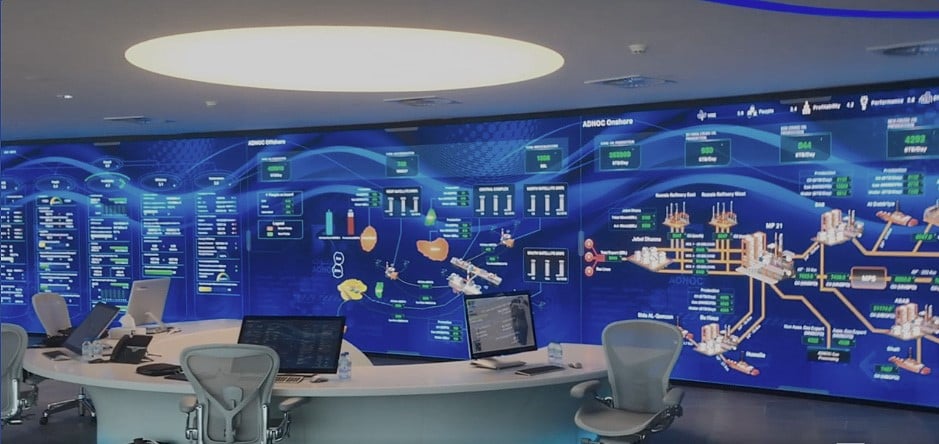
- Natively generate multi-screen views (video-wall) for the control center that allow a contextualized visualization of all operations related to the airport including the embedded integration of external applications.
Promote Initiatives 4.0
The functionalities of the Unified Control Center will allow airport managers to evolve to a more efficient model and with a clear vision towards digitization:
- The deployment of IoT sensors and integrate them into the platform. In an airport it is important to have sensors of all kinds and in all places, since all the necessary parameters must be captured to later be able to act in real time to problems or incidents; in addition, in turn these sensors feed the Historian system to store the information necessary to start and provide data to Big Data and Machine Learning tools with the aim of planning the future and anticipating events.
- Digitally integrate all the physical security management of the airport, as well as the resolution of incidents and alerts. Also integrate the maintenance teams and the GMAO/EAM platform for asset management.
- Another possibility is BIM (Building Information Modeling) and its integration with the Control Center. BIM offers the possibility of planning and maintaining the airport infrastructure through the use of digital twins. The creation of a digital twin, a virtual copy of the installation to help manage it.

In short, in the management of operations, unity is strength and the initiatives that derive from the implementation of a Unified Control Center in an airport will act as an accelerator for the transition to a smart, sustainable and efficient airport.
“Change the way you manage the company at the operations level by integrating the information into a system of systems, with the context as the main axis and a visualization adapted to the needs of each of the stakeholders.”
Get in Touch with an Expert
Fill in your information and we’ll contact you to handle your request.
"*" indicates required fields