Wireless Solutions, a Golden Springboard for Modern Industry
Wireless communication is offered as an intelligent and necessary solution for the businesses of the future, thanks to advantages that distance them from conventional connections.


Wireless connectivity is making great strides in the industry. The possibility of solving communication problems where cables are not necessary, together with the boost represented by the rise of the IIoT, gives Wireless technology the highest percentage of growth in the current market.
The landscape has changed a lot in recent times and, without a doubt, the current one is marked by the appearance of more and better ways of doing things. In this dynamic and constantly evolving environment, it is as important to highlight the value propositions of those companies that provide technological solutions, as it is of those innovative companies that incorporate them into their philosophy and strategy.
Why do we say more and better ways of doing things? Very simple: wireless communication is presented as an intelligent solution for endless situations, and stands out because it provides its users with a series of advantages.
Benefits of Wireless Communication
To begin with, it provides great mobility, which is very necessary for adapting to current architectures in plants, where the PLCs and devices that compose them are no longer just static. On the contrary, it is common to find elements that move and rotate (for example, AGVs moving through the plant, machines with rotating elements such as slip rings or brushes, etc.), thanks to a set up (or medium) that allows it.
The wiring, which in other applications stands out for its robustness, is evidently not the most recommended for the cases mentioned above. To understand each other, the required movement generates wear that, taken to the limit, can even break it and cause communication losses.
The ideal alternative for when the use of cables requires complex mechanical solutions.
On the other hand, wireless technology also allows covering long distances that are otherwise unattainable. Even acquiring relevance in any industrial sector and type of plant, it solves, above all, the problem of transmitting a signal from one side to another in locations where it is not possible to run a cable. In this sense, oil refineries, pumping stations or water treatment plants are a clear example of the great value that wireless technology brings to their sector.
Reaches remote places where wiring is not an option.
To continue, from an economic point of view, the use of wireless technology can mean a reduction in costs: dispensing with wiring not only saves the money of the cable itself, but also avoids the costly installation often necessary for its implementation.
It installs much faster than conventional wiring and reduces maintenance costs.
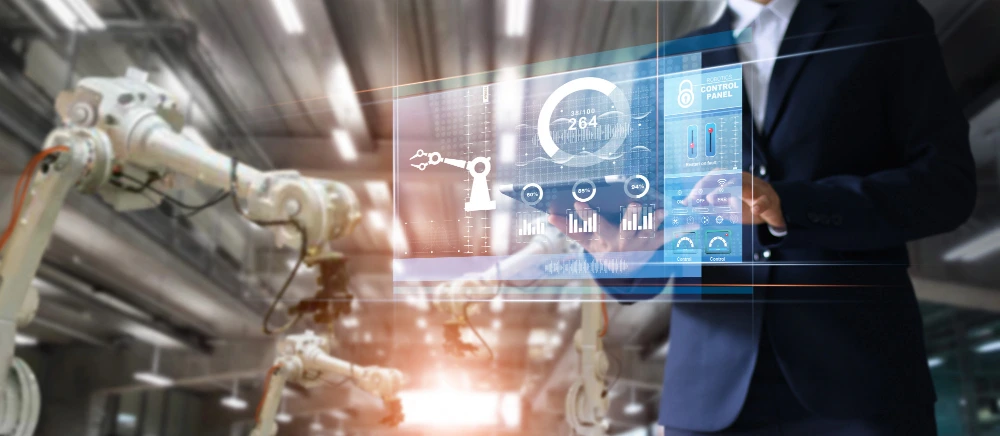
With regard to its industrial applications, wireless also helps to provide greater security to factory operators and facilitates diagnostic tasks. Workers can remotely control equipment that is in dangerous places, as well as gather information from any part of the process without interrupting the operation of the machine.
Providing machines with a wireless access point gives life to the BYOD (Bring your own device) concept that allows access to them from any device, be it a tablet or smartphone, to have data in real time and without stopping its operation.
The incorporation of intelligent devices ends the need to have expensive HMIs.
Finally, but no less important, well-applied wireless communication is a fundamental vector to achieve the flexibility so sought after in the modernization of plants.
On its way to the factory of the future, already present, it allows adaptation to a constantly changing and highly personalized demand, thanks to its wide margin of modification of the lay-out or production formats.
Gone is the mass production of a single product. Now, it is necessary to be equally profitable manufacturing small but personalized batches. Similarly, information goes from the exception to the norm. Factories in which data is a mere addition are no longer valid: organizations must connect from plant to systems and vice versa, relying, of course, on this type of technologies that bring value to the industry.